
From ATS to ARM
Why the Evolution to Applicant Relationship Management Is Urgent, Not Optional


Hiring Is Broken
Something is fundamentally wrong with how organisations find talent. Despite unprecedented investment in recruitment technology, two paradoxes persist: organisations report chronic talent shortages while qualified candidates struggle to find work; and sophisticated screening systems designed to improve hiring quality routinely exclude capable applicants while failing to identify true fit.
The cause is not technological inadequacy. It is a philosophical misdirection. For three decades, recruitment technology has optimised for the wrong objective: elimination rather than cultivation. The result is a system that treats human beings as workflow items to be processed, filtered, and, in the vast majority of cases, silently discarded.
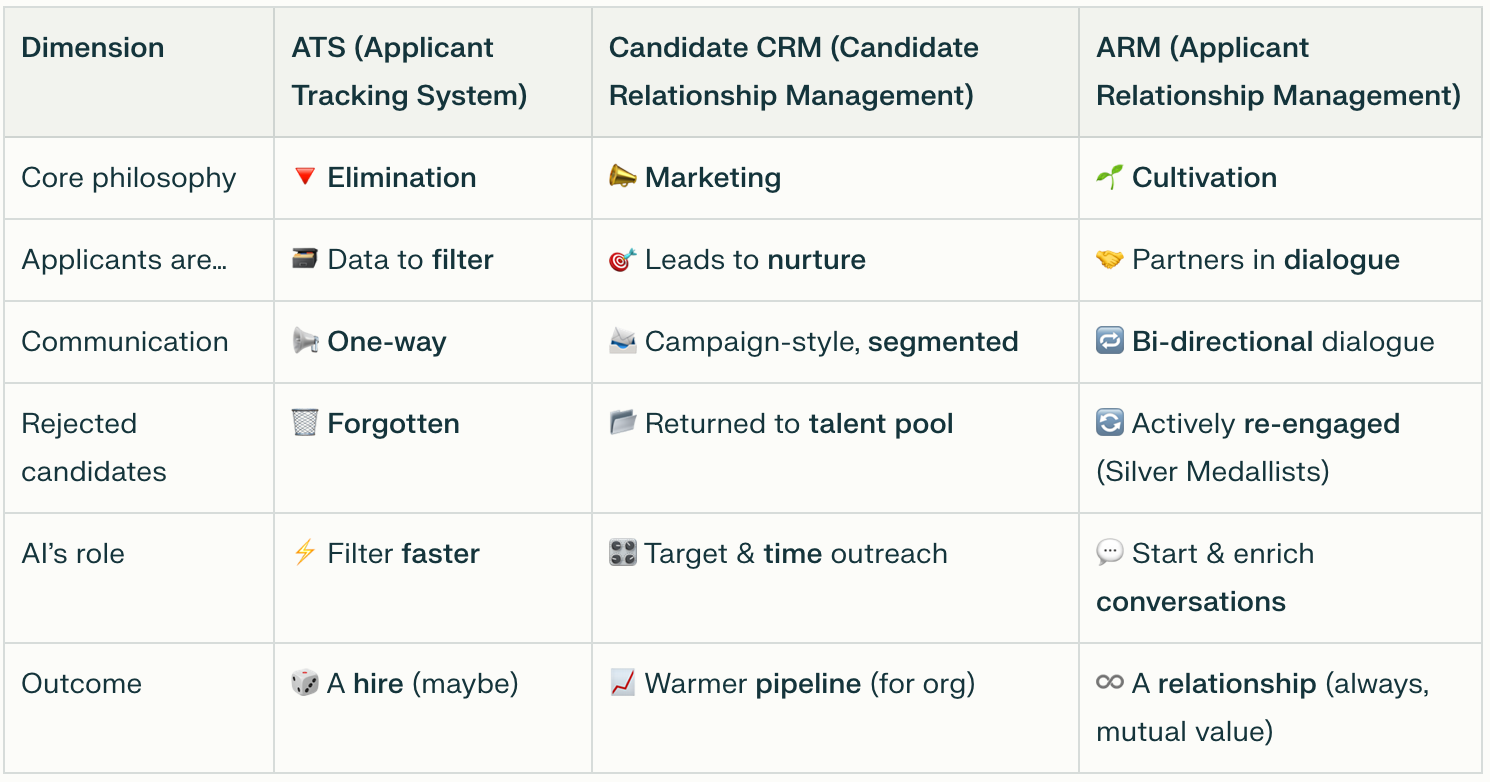
This article presents the case for a fundamental shift: from Applicant Tracking Systems (ATS) and Candidate Relationship Management (Candidate CRM) to a new paradigm we call Applicant Relationship Management (ARM). This is not incremental improvement. It is a necessary evolution that benefits organisations, people, and society.
Understanding the Current Landscape
Applicant Tracking Systems: The Elimination Engine
ATS platforms emerged in the 1990s to solve a genuine problem: managing high volumes of applications efficiently. They succeeded. Today, over 98% of Fortune 500 companies use an ATS, and the global market exceeds $2.3 billion.
But efficiency in pursuit of elimination has unintended consequences. ATS platforms are architected around a single logic: reduce the applicant pool as quickly as possible. They parse CVs, match keywords, apply knockout criteria, and produce shortlists. What happens to the 95%+ of applicants who don’t make the cut? Nothing. Silence. The relationship, if it can be called that, ends.
The human cost is significant. Job seekers invest hours crafting applications, receive no feedback, gain no insight into why they were rejected, and learn nothing that might improve future attempts. The organisational cost is equally real: every rejected applicant who had genuine potential represents a missed opportunity, and a reputational risk when they share their experience.
Candidate CRM: A Step Forward, But Not Far Enough
Candidate Relationship Management platforms represented genuine progress. Borrowing from sales and marketing, they introduced talent pools, nurture campaigns, employer branding, and multi-channel engagement. Candidates became ‘leads’ to be cultivated rather than merely applications to be processed.
Yet Candidate CRM remains fundamentally organisation-centric. It treats candidates as targets of marketing automation rather than partners in mutual value creation. More critically, it focuses on sourcing new prospects while neglecting the systematic re-engagement of past applicants, the ‘Silver Medallists’ who demonstrated genuine potential but were not selected. The relationship, such as it is, remains one-directional: the organisation extracts value from candidates, but candidates receive little in return.
The ARM Paradigm: A Fundamental Shift
Applicant Relationship Management proposes a different philosophy. Where ATS asks ‘How do we eliminate unsuitable candidates?’, and Candidate CRM asks ‘How do we market to potential candidates?’, ARM asks: ‘How do we build enduring, mutually valuable relationships with every person who engages with our organisation?’
This is not mere repositioning. ARM introduces structural innovations that distinguish it from both predecessors.
Innovation 1: Co-Creative Assessment
Traditional recruitment treats the CV as a definitive representation of the applicant, a static document interpreted unilaterally by machines and humans operating in isolation. The applicant submits; the organisation judges; the applicant waits in silence.
ARM challenges this model. The CV is an imperfect proxy for human complexity. No document can capture context, motivation, transferable skills, or growth potential. ARM therefore invites applicants to participate in their own evaluation. They receive AI-generated assessments, review the interpretation, correct misunderstandings, and provide contextual information that static documents cannot convey.
This transforms evaluation from unilateral judgement into collaborative dialogue. The applicant becomes an active participant, not a passive object.
Innovation 2: Transparency of Decision Parameters
Current systems are black boxes. Applicants don’t know what criteria triggered rejection, how their CV was interpreted, or what ‘good’ looks like for that specific organisation. They learn nothing from the experience except that they failed.
ARM shares the decision parameters. Applicants see how they were evaluated against stated criteria. Even when rejected, they understand why, and gain actionable insight for future applications. This creates procedural justice: people accept adverse outcomes more readily when they believe the process was fair and transparent.
Innovation 3: Silver Medallist Re-engagement
Every selection process produces runners-up: candidates who demonstrated genuine potential but weren’t selected for a specific role. Traditional systems discard them. ARM treats them as strategic assets.
These ‘Silver Medallists’ have already been assessed, engaged, and qualified. When new roles emerge, they represent a pre-vetted talent pool with established organisational familiarity. Re-engaging them is faster, cheaper, and more reliable than sourcing entirely new candidates, yet most organisations lack the systems to do so effectively.
Innovation 4: Bi-Directional Value Exchange
In ATS and Candidate CRM, value flows one direction: from applicant to organisation. The applicant provides information, time, and effort; the organisation extracts what it needs and moves on.
ARM creates reciprocal value. Applicants receive feedback, learning opportunities, transparent processes, and respectful engagement, regardless of outcome. The relationship generates value for both parties, which is why it persists beyond any single hiring decision.
The Three-Sided Value Proposition
ARM’s benefits extend across three interconnected stakeholder groups: organisations, people, and society. The following analysis demonstrates why adoption is urgent for each.
For Organisations: Competitive Advantage Through Relationship Equity
The talent acquisition challenge is intensifying. Skilled professionals have options; they increasingly choose employers who treat them with respect throughout the hiring process. Organisations using elimination-focused systems face a competitive disadvantage they may not even recognise.
Higher-quality shortlists. Top-tier candidates disengage from impersonal, opaque processes. They have alternatives. ARM’s engagement-centric approach retains candidates who would otherwise abandon applications mid-process or decline offers from organisations that treated them poorly during recruitment.
Reduced cost-per-hire. Silver Medallist re-engagement transforms sunk assessment costs into strategic assets. When a new role emerges, organisations can draw from pre-vetted candidates with established familiarity, faster, cheaper, and more reliable than starting from zero.
Employer brand protection. Every rejected applicant is a potential brand ambassador, or brand detractor. ARM ensures that even unsuccessful candidates leave with a positive impression, reducing negative word-of-mouth and Glassdoor complaints that damage employer reputation.
Governance and compliance readiness. Transparent, documented, auditable processes reduce legal exposure from discrimination claims. ARM’s co-creative model creates defensible records showing applicants were treated fairly and given opportunity to participate in their evaluation.
For People: Dignity, Agency, and Growth
The job seeker experience is broken. Surveys consistently report that the majority of job seekers describe the application process as frustrating, dehumanising, and opaque. They invest significant time and emotional energy, receive nothing in return, and learn nothing that might improve future attempts.
Transparency replaces mystery. ARM shows applicants how they were evaluated. They see the criteria, understand the assessment, and, crucially, learn what ‘good’ looks like for that organisation. Even rejection becomes educational rather than merely frustrating.
Agency replaces passivity. Co-creative assessment means applicants can correct misinterpretations, provide context, and highlight strengths that static CVs cannot convey. They become participants in the process rather than objects of it.
Procedural justice. Research consistently shows that people accept adverse outcomes more readily when they believe the process was fair. ARM’s transparency and participation create procedural justice that traditional systems cannot match.
Reduced ‘spray and pray’ behaviour. When job seekers receive meaningful feedback, they can target applications more effectively. This benefits them (less wasted effort) and organisations (fewer mismatched applications). The current system, which provides no feedback, incentivises indiscriminate mass applications.
For Society: Fairer Labour Markets and ESG Alignment
The labour market suffers from chronic matching inefficiency. Organisations report talent shortages; qualified candidates report inability to find suitable roles. The problem is not supply or demand, it is the mechanism connecting them.
Reduced friction. ARM’s transparency and feedback loops improve matching precision. Applicants learn what organisations actually want; organisations gain richer understanding of applicant capabilities. Better matching means less wasted effort on both sides and faster movement toward productive employment.
Inclusion of ‘hidden workers’. Research from Harvard Business School identifies millions of workers excluded by algorithmic screening despite genuine capability. ARM’s co-creative model gives these hidden workers the opportunity to demonstrate potential that keyword-matching systems miss.
SDG alignment. ARM directly supports UN Sustainable Development Goal 8 (Decent Work and Economic Growth) and SDG 10 (Reduced Inequalities). Organisations adopting ARM can credibly claim ESG contribution in their social responsibility reporting, not through philanthropy, but through core operational practice.
Reduced job seeker wellbeing burden. The psychological toll of repeated, unexplained rejection is real. ARM’s dignity-preserving approach reduces the frustration and demoralisation that afflicts millions of job seekers, with potential benefits for mental health and social cohesion.
Why Now? The Urgency of Transition
Several converging forces make ARM adoption urgent rather than optional.
AI regulation is coming. The EU AI Act and similar frameworks will require transparency and human oversight in automated decision-making, including recruitment. Organisations using opaque ATS screening will face compliance challenges. ARM’s transparent, participatory model is regulation-ready by design.
Talent expectations have shifted. Post-pandemic workers, particularly younger generations, expect respectful, transparent engagement. They will not tolerate dehumanising application processes when alternatives exist. Early ARM adopters gain competitive advantage in talent markets.
ESG pressure is intensifying. Investors, regulators, and stakeholders increasingly demand demonstrable social responsibility. Recruitment, which touches every person who engages with an organisation, is an overlooked ESG domain. ARM provides concrete, measurable social impact.
Technology enables what philosophy requires. The AI capabilities needed for co-creative assessment, transparent feedback, and intelligent re-engagement now exist. The barriers are no longer technical, they are strategic and cultural. Organisations that delay adoption cede ground to more progressive competitors.
Conclusion: From Gate to Bridge
For too long, recruitment technology has functioned as a gate: filtering, excluding, eliminating. ARM reimagines recruitment as a bridge: connecting organisations with talent through relationships built on transparency, respect, and mutual value.
This is not soft idealism. It is a strategic necessity. Organisations that persist with elimination-focused systems will find themselves at competitive disadvantage, struggling to attract talent, exposed to regulatory risk, and unable to demonstrate the social responsibility that stakeholders increasingly demand.
The evolution from ATS to ARM is urgent. The technology exists. The philosophy is clear. The benefits, for organisations, for people, for society, are demonstrable. What remains is the decision to act.
The question is not whether recruitment will transform. It is whether your organisation will lead that transformation, or be disrupted by it.
Antonio Specchia is the author of Customer Relationship Management (CRM) for Medium and Small Enterprises (Routledge, 2022), founder of NoesisHiring.ai, he Co-authored “Applicant Relationship Management (ARM): A 21st Century Paradigm to Transform Talent Acquisition in Support of Sustainable Corporate Governance” as he is the creator of the Applicant Relationship Management (ARM) paradigm.